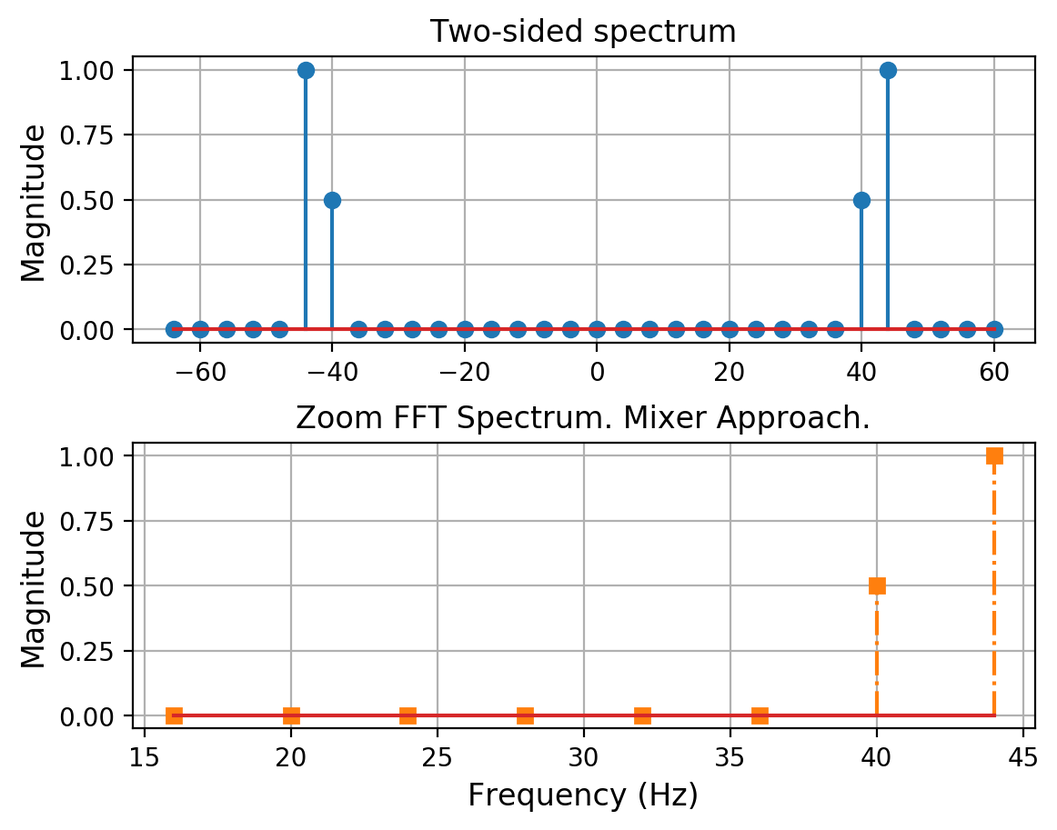
Implementing the Zoom FFT mixer approach in Python
Zoom FFT
Zoom FFT was used to analyze a frequency subband. The idea behind zoom FFT is to retain the exact resolution, which could be achieved with a full-size FFT on the original signal, by computing a small-size FFT on a down-sampled shorter signal. Thus, the efficiency of FFT could be improved while maintaining the exact resolution.
This is intuitive: for a decimation factor of $D$, the new sampling rate is $f_{sd} = f_s/D$, and the new frame size (and FFT length) is $L_d = L/D$, so the resolution of the decimated signal is $f_{sd}/L_d = f_s/L$.
Implementation
The Mixer Approach
See Zoom FFT: The popular mixer Zoom FFT method consists of first shifting the band of interest down to DC using a mixer and then performing lowpass filtering and decimation by a factor of BWFactor (using an efficient polyphase FIR decimation structure).
Note: For short signals, the polyphase FIR design is tricky. Sometimes, it will distort the spectrum. In the Matlab example, the transient filtering effects were eliminated by repeating the filtering ten times. So, the conventional Fourier resampling method is recommended here.
Python Codes
- Import modules
import numpy as np
from matplotlib import pyplot as plt
from numpy import pi
from numpy.fft import fft, fftfreq, fftshift
from scipy import signal
- Generate signal
def SineWave(f, fs, length, amplitude=1):
    x = amplitude * np.sin(2 * pi * f / fs * np.arange(length))
    return x

L = 32
fs = 128
res = fs/L
f1 = 40
f2 = f1 + res
x = SineWave(f1, fs, L) + SineWave(f2, fs, L, 2)
- Plot the original FFT
X = fft(x)
freq = fftfreq(L, d=1/fs)

fig1, ax1 = plt.subplots(2)
#fig1.clf()
ax1[0].stem(fftshift(freq), abs(fftshift(X)) / L)
#ax1[0].set_xlabel('Frequency (Hz)', fontsize=12)
ax1[0].set_ylabel('Magnitude', fontsize=12)
ax1[0].set_title('Two-sided spectrum', fontsize=12)
ax1[0].grid()
- Zoom FFT using a mixer approach
BWOfInterest = 48 - 16
Fc = (16 + 48) / 2
BWFactor = np.floor(fs / BWOfInterest).astype(np.uint8)

# mix the signal down to DC and filter it through the FIR decimator
indVect = np.arange(L)
y = x * np.exp(-1j * 2 * pi * indVect * Fc / fs)
xd = signal.resample(y, 8)
# polyphase method as in Matlab
#indVect = np.arange(L * 10)
#y = np.tile(x, 10) * np.exp(-1j * 2 * pi * indVect * Fc / fs)
#beta = signal.kaiser_beta(80)
#xd = signal.resample_poly(y, up=1, down=BWFactor, window=signal.get_window(('kaiser', beta), 6))
#xd = xd[-len(xd) // 10:]
#xd = xd[-2 * len(xd) // 10:-len(xd) // 10]
fftlen = len(xd)
Xd = fft(xd)

Ld  = L / BWFactor;
fsd = fs / BWFactor;
F   = Fc + fsd / fftlen * np.arange(fftlen) - fsd / 2
ax1[1]. stem(F, np.abs(fftshift(Xd)) / Ld, linefmt='C1-.', markerfmt='C1s')
ax1[1].grid()
ax1[1].set_xlabel('Frequency (Hz)', fontsize=12)
ax1[1].set_ylabel('Magnitude', fontsize=12)
ax1[1].set_title('Zoom FFT Spectrum. Mixer Approach.', fontsize=12)
fig1.subplots_adjust(hspace=0.35)
Result
The following result is the same as in Zoom FFT but much faster.